Verified local resource
Household Hazardous Waste Disposal in Allegheny County
PRC lists registration closed for the September 19 South Park chemical event as of September 11. Check your options before loading; existing ticket holders can use the preparation guide below.
Updated September 11, 2026 . See individual source verification dates below.
South Park on September 19: registration is closed
Checked September 11, 2026: PRC’s household chemical schedule lists registration closed for the September 19 South Park event. The County still lists the date, but a calendar listing is not an available appointment. Do not load the car and drive there without a reservation. Recheck the organizer for any change; this guide cannot reserve a place.
For residents who already have a booking, the County’s published event details are:
Saturday, September 19, 2026, 9:00 a.m.–1:00 p.m.
South Park Wave Pool parking lot
Corrigan Drive and 100 Acres Drive
Bethel Park, PA 15102
Open the County’s directions to South Park Wave Pool. Match the location to your booking confirmation; the County’s earlier 2026 events used North Park and Boyce Park.
The date above is a 2026 event record, not a recurring annual appointment. After September 19, use the organizer’s live schedule for another date. The rules and fees in the County and PRC sections below were rechecked September 11; other sources retain their original retrieval dates.
No booking? Compare the next step before moving chemicals
| Your situation | Useful next step | Do not assume |
|---|---|---|
| You already booked South Park | Check the September 19 confirmation, sort the load using the accepted list, and follow the trunk/truck-bed rule. | An extra vehicle or a different event is covered by the same booking. |
| You missed South Park registration | Check PRC’s live chemical schedule. On September 11 it also listed October 3, 2026 at Bradys Run Park Recycling Center in Beaver County, with a registration link. Confirm eligibility and a place before planning the trip. | A registration link guarantees tickets, or a Beaver County event has identical local eligibility rules. |
| You live in the City of Pittsburgh | Compare the separate City appointment program described below. | A Pittsburgh mailing address automatically means City residency. |
| Your load is mainly a TV, tires, or fluorescent tubes | Use the electronics and hard-to-recycle event guide and confirm each material with that organizer. | A household chemical event accepts every hard-to-recycle item. |
| A container is leaking, unlabeled, or not on the accepted list | Call PRC at 412-488-7490 for guidance before transporting it. | Putting it in a box changes the event’s exclusion list. |
This is the countywide household chemical event series. City of Pittsburgh residents also have a separate 2026 city-vendor program for weekly drop-offs, curbside appointments, and city community events. The confirmation for the program you select controls where and when you should go.
What counts as household hazardous waste here?
The practical definition is the event’s accepted list, not whether a product looks dramatic or has the word “hazard” on its label. Everyday garage, basement, workshop, garden, and cleaning products may need special handling.
The county lists these categories as accepted:
- Aerosol cans
- Automotive fluids, including motor oil, transmission fluid, antifreeze, kerosene, and brake fluid
- Household batteries
- Camp fuel and small propane bottles
- Compact fluorescent light bulbs, but not fluorescent tubes
- Electronic cigarettes
- Gasoline and kerosene
- Household cleaners such as ammonia, drain openers, acid cleaners, and oven cleaners
- Mercury thermometers
- Paint products, including latex paint, oil-based paint, thinners, strippers, creosote, rust preservatives, and water sealers
- Pesticides and garden chemicals, including insecticides, weed killers, rodent killers, mothballs, and fertilizer
- Photo chemicals, pool chemicals, and smoke detectors
If your item is not clearly included, do not guess. Call PRC at 412-488-7490 before placing it in the vehicle. The Pennsylvania DEP program directory advises residents to contact collection programs in advance because sites may differ in the materials they accept.
What the event will not accept
The county’s exclusion list is just as important. Do not bring:
- Ammunition, explosives, or flares
- Appliances
- Commercial or industrial waste
- Large grill or medical compressed-gas cylinders
- Fluorescent tubes
- Medical waste, needles, or sharps
- Prescription or non-prescription drugs
- PCBs, dioxins, or radioactive materials
- Tires
- Leaking containers
An excluded material still needs an appropriate disposal route; “not accepted here” does not mean “put it in recycling.” The Allegheny County Health Department’s recycling page and resource directory can help identify alternatives for hard-to-recycle materials. For ammunition, explosives, radioactive items, or an active chemical emergency, use the appropriate public-safety channel rather than transporting the material to a community event.
The program is restricted to household quantities. Chemical waste generated by a business, contractor, institution, or industrial operation is not eligible. PRC asks commercial generators to contact the organization for assistance identifying a compliant option.
2026 fees and payment
The published standard event fee is $20 for every 10 gallons or 50 pounds per vehicle. PRC also lists:
- $12 per fire extinguisher
- $15 per pound of liquid mercury
- A fee determined on site for oversized loads
The County says all forms of payment are accepted, with cash preferred, for its household chemical events. Review your confirmation because this payment policy is different from Pittsburgh’s separate city-vendor program, which says cash and checks are not accepted.
Do not try to estimate the charge by counting containers alone. Partially full cans and bottles still contribute to the load, and staff assess the materials brought to the event. If you have an unusually large household cleanout, call ahead so you do not discover at the gate that the load needs different arrangements.
How to pack the vehicle safely
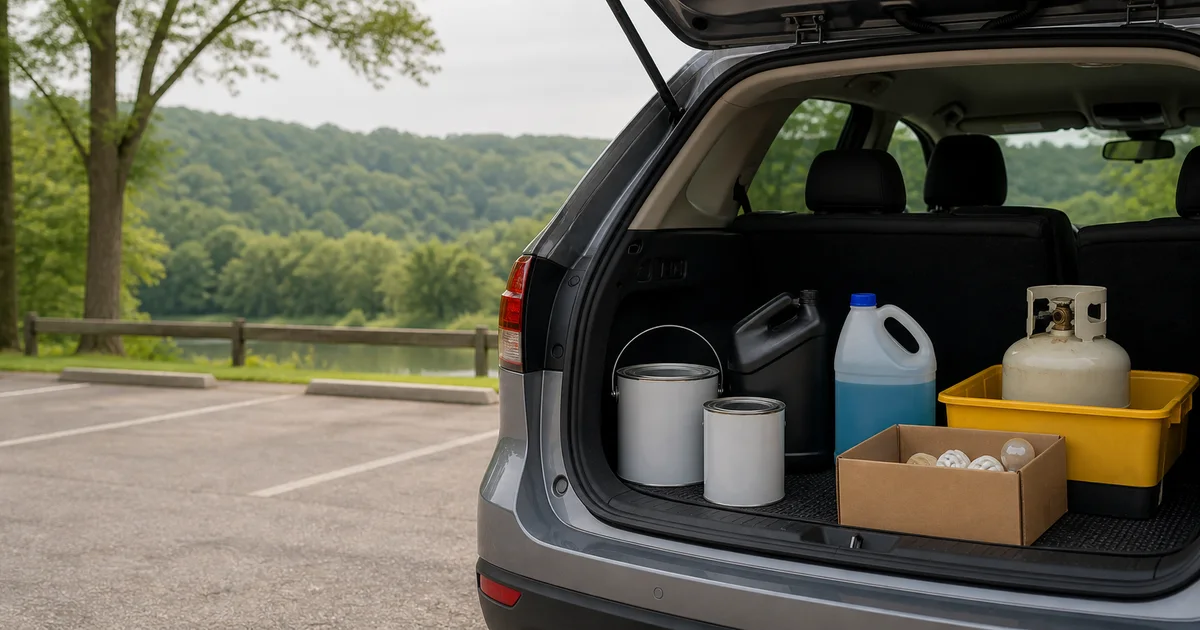
The official event rules say all items must be placed in a car trunk or truck bed and participants must remain in the vehicle while the contractor unloads. That keeps people out of the work area and lets trained staff handle the transfer.
Use this preparation sequence:
- Keep products in original containers when possible. An intact label helps staff identify the contents.
- Close every cap and lid. Do not bring a container that is actively leaking; the official list excludes leaking containers.
- Keep incompatible products separate. Never combine leftovers to save space. Mixing household chemicals can cause heat, pressure, fumes, or reactions.
- Use a sturdy secondary box or tray. Keep containers upright so they cannot roll. Protect bulbs and glass thermometers from breakage.
- Use the car trunk or truck bed required by the organizer. If your vehicle has neither, ask PRC how to use that vehicle before loading. Do not place chemicals loose on passenger seats.
- Make the load easy to reach. Staff should not have to move groceries, tools, or personal belongings to reach the chemicals.
- Carry the registration confirmation. PRC says a printed ticket is unnecessary; staff can scan the code from a phone or look up a participant by name.
The line closes at 1:00 p.m., and PRC says vehicles already in line at that time will be unloaded. Arriving with a reservation, sorted load, and accessible confirmation will make the process smoother.
Which program should a Pittsburgh resident use?
If you live inside Pittsburgh city limits, you have two distinct choices to compare:
- City of Pittsburgh vendor program: recurring Tuesday/Thursday appointments, curbside appointments, and city collection events; registration and card payment are required.
- Allegheny County/PRC household chemical events: scheduled Saturday regional events using the county/PRC fee structure and accepted-material list described on this page.
Choose based on eligibility, available dates, accepted items, location, and total cost. Do not combine instructions from the two programs—for example, showing up at a county event with a city-vendor confirmation or assuming one program’s payment policy applies to the other.
Electronics are another point of separation. The county chemical event page is designed around household chemicals. For televisions, computers, monitors, and related devices, see our Pittsburgh electronics recycling guide or consult the county and PA DEP electronics directories for a program open to your municipality.
Avoid these common disposal mistakes
- No registration: Pre-registration is mandatory, even when an event appears on a public calendar.
- Late arrival: The published hours end at 1:00 p.m. Build in time for traffic and event lines.
- Leaking cans in the trunk: The event excludes leaking containers. Call for guidance instead of risking a spill in the vehicle.
- Unlabeled mixtures: Never pour several products into one jug. Keep each material separate and identifiable.
- Commercial loads: A home-based cleanup is not automatically household waste if the material was generated by business activity.
- Fluorescent tube confusion: CFL bulbs are accepted, but the official exclusion list says fluorescent tubes are not.
- Large-cylinder confusion: Small propane bottles are accepted; large grill or medical compressed-gas cylinders are excluded.
- Assuming every event takes the same items: DEP warns that program details vary. Recheck the event page and confirmation each time.
Before leaving home
- Check the organizer’s current status and your existing registration; September 19 registration was closed at the September 11 check.
- Match every item to the accepted list.
- Remove prohibited, commercial, or leaking materials.
- Estimate the load and review the fee structure.
- Seal containers, keep labels, and separate incompatible products.
- Pack materials upright in the trunk or truck bed.
- Bring the registration code and a payment method.
- Stay in the vehicle and let event staff unload.
Household chemical collection is easiest when the sorting happens at home. A careful ten-minute review can prevent a rejected load, a vehicle spill, or a wasted trip across Allegheny County.
Primary sources
- Household Chemicals Collection
Allegheny County · Retrieved 2026-09-11
- Household Chemicals
Pennsylvania Resources Council · Retrieved 2026-09-11
- Household Hazardous Waste Collection Programs
Pennsylvania Department of Environmental Protection · Retrieved 2026-08-17
- Pittsburgh E-Waste and HHW Recycling Programs
Noble Environmental · Retrieved 2026-09-11
- Recycling
Allegheny County Health Department · Retrieved 2026-08-17
Frequently asked questions
Can I still register for the September 19 South Park chemical event?
PRC listed registration closed when checked September 11, 2026. Do not travel without an existing reservation or a new confirmation from the organizer. Check PRC's live household chemical schedule for changes and other events.
Do I need to register for an Allegheny County household chemical event?
Yes. Allegheny County and the event operator both state that pre-registration is required. A calendar date alone does not reserve a place.
Can I bring latex paint to an Allegheny County chemical collection?
Yes. The official accepted list includes latex and oil-based paint as well as related products such as thinners, strippers, and water sealers.
How much does the Allegheny County household chemical event cost?
The published standard fee is $20 for every 10 gallons or 50 pounds per vehicle. Additional fees apply to fire extinguishers, liquid mercury, and oversized loads. Confirm during registration.
Can a business bring chemical waste to these events?
No. The program is restricted to household quantities and excludes commercial and industrial waste. Businesses should contact a licensed waste service for appropriate handling.